


2017-02-26
Совмещение волн в однослойной катушке. Инструкция
Модуляция. Кратные частоты
Известно, что в катушках с отношением H/D более единицы, частота стоячей волны выше частоты LC-резонанса,
поэтому для их совмещения нужно применять искуственные методы повышения последней.
Один из методов — модуляция основной частоты при помощи более низкой, кратной основной.
Модуляция разбивает энергию первой гармоники на спектр, состоящий из частот находящихся в левой и правой области, если считать основную частоту центром.
Нас будет интересовать только правая часть спектра,
в которой частоты будут образовываться по следующему правилу:
\[F = f + {f \cdot i \over N} \quad N \in 2, 3, 4, 5, ... \]
где: \(F\) — полученная частота из спектра,
\(f\) — основная частота LC-резонанса (резонансаня частота катушки),
\(i\) — номер гармоники модуляции (целое число),
\(N\) — кратность частоты модуляции.
Более наглядно всё это изображено на следующем рисунке.
На нём слева показаны импульсы, подаваемые на индуктор катушки, а справа — спектр частот образованный этими импульсами.
Номер гармоники \(i\) показан белым цветом.
Вообще говоря, если мы рассматриваем идеальные пачки импульсов, как слева на рисунке, то чётные гармоники при модуляции должны отсутствовать.
Но в реальности, катушка имеет свою добротность, поэтому в начале пачки её амлитуда плавно нарастает, а по её окончании постепенно спадает.
Пачка получается несимметричной, а значит, — в спектре будут присутствовать и чётные гармоники, что отражено на рисунке справа.
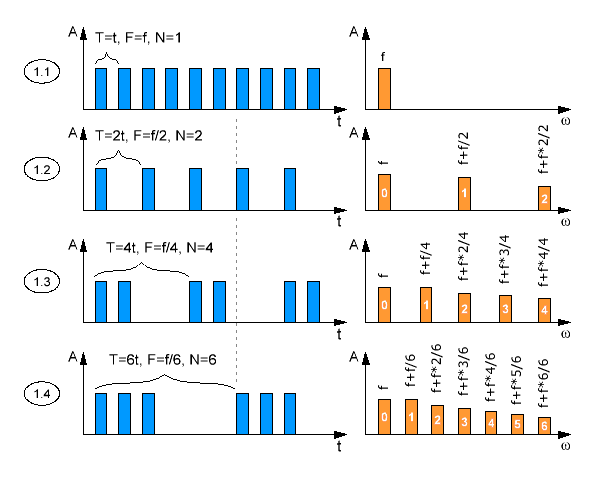
Видно, что если основную частоту не модулировать (рисунок 1.1), то спектр будет состоять только из одной частоты — основной.
Этот режим \(N=1\) установлен в калькуляторе по умолчанию.
Если основную частоту промодулировать в два раза меньшей (\(N=2\)), то спектр будет состоять из таких частот:
\(f+f\frac12,\, f+f\frac22,\, f+f\frac32\) и т.д.
Как видим, для такой модуляции из импульсной последовательности просто убирается каждый чётный импульс.
Если же модуляция осуществляется частотой в четыре раза меньше основной \(N=4\), то спектр будет состоять из таких частот:
\(f+f\frac14,\, f+f\frac24,\, f+f\frac34\) и т.д.
Для этой модуляции — из последовательности в четыре импульса нужно убрать каждый 3-й и 4-й.
И т.д.
Нужно заметить, что любую частоту из спектра можно совместить с частотой стоячей волны, что и может делать калькулятор.
При выборе параметра «Кратность частоты модуляции» больше единицы (\(N \gt 1\)),
на графике калькулятора будут отображаться гармоники из рисунков 1 и 2.
Если выбран параметр «Гармоники модуляции» например от 1 до 3,
то на этом графике будут представлены эти гармоники оранжевым цветом снизу вверх: внизу первая, в средине — вторая, вверху третья.
Слева от графика даётся величина резонансной частоты катушки в выбранной точке пересечения.
Для получения графика основной частоты, в левое поле «Гармоники модуляции» нужно поставить ноль.
Модуляция. Кратные частоты. Нечётная кратность
Как же сделать модуляцию с частотой в кратности 3, 5, 7 и т.п. от основной?
Мы не будем рассматривать вариант, когда импульсы задающего генератора дробные (хотя в конце концов можно сделать и так), а пойдём путём изменения скважности пачки импульсов.
Так например, для \(N=3\) из последовательности в три импульса мы убираем каждый третий, а для \(N=5\) — каждые 4-й и 5-й импульсы.
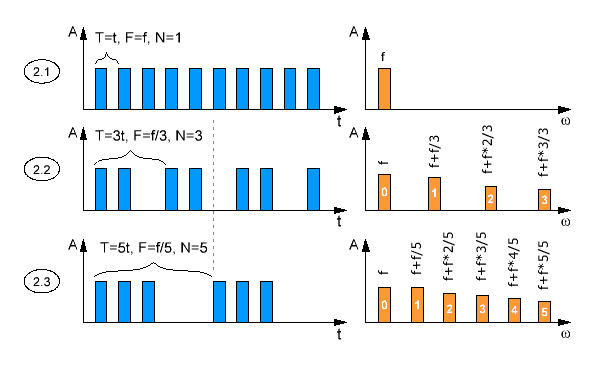
Можно поступить и по-другому: для \(N=3\) из последовательности в три импульса убрать каждый 2-й и 3-й,
а для \(N=3\) из последовательности в пять импульсов убрать каждый 3-й, 4-й и 5-й.
В этих случаях общая энергетика спектра будет меньше, а амплитуды более высоких гармоник вырастут по отношению к более низким.