В качестве предисловия к дальнейшему повествованию, как нельзя лучше подойдёт выдержка из ответа Николы Тесла в разговоре со своим адвокатом.
В этой работе мы рассмотрим некоторые свойства трансформатора Тесла (ТТ),
построим математическую модель одного из способов его возбуждения и сделаем выводы об эффективности съёма энергии с его вторичной обмотки на первой гармонике.
Для этого будем рассматривать классическую схему возбуждения трансформатора с помощью пачек импульсов,
посылаемые генератором GI в первичную обмотку — L1.
Длительность одного импульса генератора равна \(T_{i}\), длительность всей пачки — \(T_{p}\),
периода пачек — \(T\),
а скважность будем находить в виде: \(Q = \frac {T} {T_{p}}\).
В этой работе, для упрощения нашей модели, будем применять относительные величины,
поэтому величина амплитуды импульсов Vi и длительность периода пачек будут равны единице.
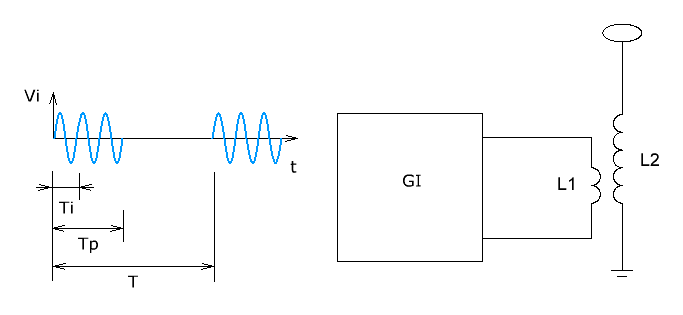
Фактически имеем генератор с основной частотой \(f_{i} = 1 / T_{i}\) ,
которая промодулирована более низкой частотой \(f = 1 / T\) со скважностью \(Q\).
Это важное условие необходимо для съёма мощности в нагрузку без вмешательства в волновые процессы во вторичной обмотке ТТ — L2.
Будем делать это на низкочастотной гармонике,
а для удобства съёма, в качестве таковой, выберем частоту модуляции \(f\).
Амплитуду этой гармоники обозначим \(H_{1}\), а её значение ищем с помощью Фурье-анализа колебаний из L2.
На нём здесь мы останавливаться не будем, т.к. это целый раздел в математике;
его можно изучить нашим читателям отдельно,
посмотреть спектр сигнала в
онлайн калькуляторе
или проверить всё в
MathCAD-е.
Зная \(H_{1}\), мы можем найти эффективное (среднеквадратичное) значение амплитуды первой гармоники за период \(T\):
\[ A_{1} = H_{1} \sqrt {\int^1_0 \sin (2\pi \cdot f \cdot t)^2 \, dt} \]
Эффективное значение амплитуды задающей частоты, которую вырабатывает генератор GI, находим так:
\[ A_{GI} = \sqrt {\int^{1/Q}_{0} \sin (2\pi \cdot f_i \cdot t)^2 \, dt} \]
Их отношение — так:
\[ K_A = \frac {A_{1}} {A_{GI}} \]
Если учесть, что квадрат \(A_{GI}\) пропорционален входной мощности,
а квадрат \(A_{1}\) выходной, то можно ожидать прироста
КПД второго рода в таком виде:
\[ K_{\eta2} = \bigg ( \frac {A_{1}} {A_{GI}} \bigg ) ^{2} .\]
Условия высокого КПД
Рассмотрим в специальном онлайн-калькуляторе пример, в котором задающая частота \(f_i\) равна 10,
скважность \(Q\) равна 2,
а постоянная времени вторичной обмотки L/R, которая находится как отношение её индуктивности к активному сопротивлению, равна 0.07 —
пример №1.
Как видим из примера, амплитуда первой гармоники очень маленькая, поэтому эффективность съёма на ней также будет невысокой.
Исключение составит метод съёма, при котором он производится с токового конца ТТ с помощью магнитного сердечника.
В этом случае результирующие данные нужно умножить на коэффициент увеличения КПД полученный от перераспределения зарядов.
Попробуем изменить начальные параметры: уменьшим \(f_i\) до единицы —
пример №2.
Как видим, первая гармоника существенна возросла, а значит увеличился и главный результирующий параметр — отношение эффективных значений,
квадрат которого — это прирост требуемого нам КПД.
Но пока он всё же меньше единицы.
Для качественного перехода через единицу нам потребуется увеличение скважности и подгонка L/R.
Попробуем поставить скважность порядка 30-ти и чуть увеличим L/R —
пример №3.
Видим, что хоть абсолютное значение амплитуды первой гармоники и уменьшилось, но выросло относительно эффективного значения задающей частоты.
А \(K_A\) стало равным единице!
Обратите внимание на изменение формы импульса во вторичной обмотке ТТ — он стал почти однополярным!
Если представить себе задающий импульс от генератора, то он будет ещё более коротким.
В этом и заключается главная проблема, которую мы осветим дальше.
Попробуем ещё увеличить скважность, до 200 —
пример №4.
Получили прирост в 2.2 раза! Казалось бы, увеличивай скважность и получай высокую прибавку. Но!
Обратите внимание на длительность задающего импульса:
при скважности 2000 и рабочей частоте вторички ТТ в 420 кГц, длина этого импульса должна быть всего 1.2 нс —
пример №5.
Такой генератор наносекундных импульсов не каждому под силу сделать и даже разрядники далеко не всегда могут себе такое позволить.
Поэтому знаменитый Тесла использовал в разрядниках магнитные прерыватели искры.
Обратим своё внимание на другой важный параметр — постоянную времени вторички ТТ.
Попробуем его подобрать оптимальным образом: если его сделать слишком маленьким или слишком большим,
то эффективность ТТ только упадёт; нужно найти оптимум —
пример №6.
В реальной схеме для этого в первичной обмотке подбирают активное сопротивление, которое ставится к ней последовательно или параллельно.
В заключение хотелось бы отметить, что для получения высокого КПД при таком способе возбуждения, самым важным параметром является скважность.
При достаточно быстрых генераторах наносекундных импульсов можно получать хорошие КПД в реальных устройствах.
Например, если такой генератор может выдать импульсы длительностью в 2 нс, то тогда, при частоте вторички ТТ в 420 кГц, можно будет увеличить скважность до 1200.
А это означает, что КПД по мощности может достигать порядка 40-ка —
пример №7.
Ограничением же общего роста КПД является не только сложность в получении наносекундных задающих импульсов,
но и
максимальная мощность,
при которой энергия всех электронов будет преобразовываться из реактивной в активную.
Более совершенный расчёт импульсной технологии предложен
здесь.

